Don't jump today.
Water is 1.2 m deep today.82% LIKELY TO HURT
- Water level down since the dry spell
- Gusts from the north after 4 pm
Ask why ↓
How we think
Your agent has memory. It doesn't have judgment yet. Here is what we mean by judgment, and the five principles we hold ourselves to.
Don't jump today.
01 · Memory is not judgment
Agents rarely fail for lack of information. They fail with the right information in front of them.
Memory answers what an agent knows. Context answers what is happening right now. Judgment answers what to do, and whether to act at all.
A memory system will tell you a customer bought a box of cookies on November 27. Context tells you it was Black Friday and she paid 30% less. If you are pricing those cookies next week, the first fact tells you nothing, and the second lets you start deciding. It still isn't judgment. It is what judgment needs to work.
Receipt #2711 · One box of cookies
Three ways agents fail with the answer right there
02 · What judgment is
One jump, broken down
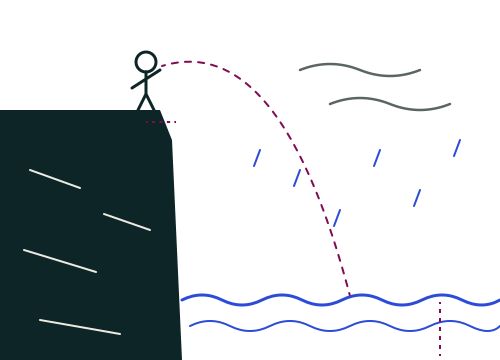
The state of things
The rock, your body, what you have on.
How they relate
How far you are from the edge. How deep the water is.
What's happening around you
The wind. The rain.
=the odds of getting hurt × what it costs if you're wrong
It will tell you not to. Not because it judged the jump. It doesn't know how deep the water is, whether there's wind, or whether you've jumped off this cliff a hundred times.
A chatbot, with memory
should I jump off this cliff?
I'd strongly advise against it. Cliff jumping can cause serious injury. Please consult a professional.
A judgment layer, on this cliff
Jump. Left ledge, feet first.
Deciding is betting. A good agent isn't the one that remembers the most, it's the one that bets best. And sometimes the best bet is not to jump, or to ask someone who knows this cliff.
03 · Not just more context
Context tells an agent what is happening. Judgment decides what to do about it. You can hand an agent perfect context and still get the wrong call, because nothing in the context says which option has the best odds or what a mistake costs.
Context graphs and decision traces tell an agent how a case was handled before. That is useful, and it is still context. It doesn't tell the agent whether this case is the same, or whether to act now.
Context also expires. The right call before a line went down is the wrong call an hour later. Judgment has to be made again every time the situation moves.
Same context, one hour apart
04 · Not just guardrails
Guardrails are rules written in advance about what an agent must never do. They matter, and they are not judgment. Most real decisions aren't between allowed and forbidden. They are between several allowed options with different odds and different costs.
Rules also break where operations actually live, in the exceptions nobody wrote down. Every new rule is a guess about a future case, and stacking them makes an agent more cautious without making it better.
Judgment works the other way around. Instead of listing what not to do, it weighs every option it has, including not acting, and picks the one with the best odds.
The rulebook
05 · How we apply it
What we hold ourselves to every time Intelital makes a call, for a person or for an agent.
Principle 01
Every operation already has people making these calls, usually in a spreadsheet, usually well. We start from what they would have done. A recommendation has to beat that plan and show why, or it doesn't belong in front of anyone.
The planOrder 40 tons on Monday.
The callOrder 32 now, 8 on Thursday. Here is why.
Principle 02
Sometimes the best a system can do is decide exactly what an experienced planner would. Sometimes it sees something they can't. When a person accepts, rejects, or adjusts a call, that answer is stored with the case, and it is how the system learns which situation it is in.
Principle 03
The constraint that decides the outcome often lives on a sticky note under someone's monitor. No ERP holds it. It shows up when a person rejects a call and says why, so we ask, and we keep the answer.
Principle 04
Most tools pick between options inside fixed limits. Some of the best decisions change the limits. Move the deadline, split the order, pay for overtime once so you don't pay for it every week.
Principle 05
An agent should act on its own when it is confident and a mistake is cheap. It should stop and ask the one person who knows when it isn't sure, or when being wrong is expensive. Escalating is a decision too.
Sure + cheapAct.
Unsure or costlyAsk the one person who knows.
The short version
Start from the planner. Learn from every no. Look past the options on the table. Know when to ask.
What principle 03 looks like in practice
✓No back-to-back flavors on line 3Rule · checked on every call
Now part of every call.
06 · What it means for your agents
Before your agent acts
Before it commits a scarce resource (inventory, a truck, cash, someone's time), it should know what the move is worth, how sure it is, and which constraint limits it.
An agent that can only act will act.
With its reasons and what happened after. That record is the only place your company's judgment can be learned from.
Most agent benchmarks check completion. Completion says nothing about whether the call was right. Score decisions against what happened.
Intelital is building the judgment layer agents and operators will be able to call before they act. It will work across the systems you already run, from the ERP to the planners' spreadsheets, and return the call, the reasons behind it, and when to hand it to a person. The example below shows what a call could return.
Example · Two late orders, one truck · What comes back
One decision to start
We'll show you how we'd make it.